It’s easy to think of history as a story told by men, about men. But when you really look, you see women have always been there, making big moves. They’ve been queens, fighters, thinkers, and artists, shaping the world in ways we’re still discovering. This article is all about shining a light on some of these incredible women, the most powerful females in history, whose actions and ideas changed everything. They faced tough times and often had to fight harder just to be heard, but they did it. Let’s get to know some of them.
Key Takeaways
- Throughout history, women have been powerful agents of change in politics, science, arts, and social justice, often overlooked.
- Legendary monarchs like Hatshepsut and Elizabeth I reshaped their nations through strong leadership and cultural influence.
- Revolutionaries and warriors such as Rosa Luxemburg and Amina of Zaria ignited social change and expanded empires through their courage and vision.
- Modern leaders like Jacinda Ardern and Angela Merkel have demonstrated effective leadership, especially during times of crisis.
- Trailblazers in science and art, including Marie Curie and Frida Kahlo, broke barriers and left lasting impacts on their fields.
Legendary Monarchs Who Reshaped Their Nations
Hatshepsut: The Pharaoh Who Ruled Ancient Egypt
Hatshepsut, ruling in the 15th century BCE, stands out as one of ancient Egypt’s most successful pharaohs. She wasn’t just a queen consort; she took on the full title and power of Pharaoh, a move that was pretty unusual for the time. For over two decades, she guided Egypt, focusing on trade and big building projects rather than war. She brought back valuable goods like ebony and incense, and commissioned impressive structures, including her magnificent mortuary temple at Deir el-Bahri. Sadly, much of the evidence of her reign was later erased, likely by her successor, Thutmose III, who probably didn’t want a female ruler setting a precedent.
Elizabeth I: Guiding England’s Golden Age
Elizabeth I, who reigned for nearly 50 years in the 16th century, is often called the "Virgin Queen." She took the throne after her half-sister Mary I died and managed to steer England through a period of significant cultural growth, now known as the Elizabethan Era. Her court was a hub for artists and thinkers. Elizabeth was incredibly smart and spoke several languages, using her sharp mind to navigate both calm and stormy political waters. She also encouraged exploration, which helped England’s economy grow and boosted its standing in the world. She proved that a woman could rule just as effectively, if not more so, than any man. Her dedication to her country was clear, always putting its needs first.
Queen Victoria: Empress of a Global Power
Queen Victoria ascended the throne at just 18 and ruled for an impressive 63 years, overseeing a massive British Empire that spanned the globe. Her reign, the Victorian Era, was a time of huge changes in culture, science, and society. Despite her small stature, she had a giant impact. She worked to maintain peace and introduced important reforms, like ending slavery in all British colonies and expanding voting rights. Her steady leadership helped restore faith in the monarchy, making it more popular than it had been in a long time. Her reign saw the empire grow significantly, and she worked to keep it stable through reforms and diplomacy.
Revolutionaries Who Ignited Social and Political Change
History books often focus on the male figures who led revolutions and shook up the world. But let’s be real, women were right there in the thick of it, driving change and challenging the status quo, even when it was incredibly tough. These women weren’t just bystanders; they were the sparks that ignited movements, pushing for a different kind of future.
Rosa Luxemburg: Voice of the European Left
Rosa Luxemburg was a force to be reckoned with in early 20th-century Europe. A Polish-German Marxist theorist, philosopher, economist, and revolutionary socialist, she was a fierce critic of capitalism and a passionate advocate for internationalism. She didn’t shy away from speaking her mind, even when it meant going against the grain of her own political party. Her writings on war, imperialism, and the role of the masses in revolution are still studied today. She believed that true social change had to come from the people, not just from leaders.
- Key Beliefs:
- Advocated for spontaneous mass action and workers’ councils.
- Opposed World War I, seeing it as an imperialist conflict.
- Championed democratic socialism and international solidarity.
Indira Gandhi: India’s First Female Prime Minister
Indira Gandhi was a towering figure in Indian politics. As the first and only female Prime Minister of India, she led the country through some of its most challenging times. Her political career was marked by bold decisions, from leading India to victory in the 1971 Indo-Pakistani War to implementing economic reforms. She was a complex leader, admired by many for her strength and decisiveness, and criticized by others for her authoritarian tendencies. Regardless of opinion, her impact on India and global politics is undeniable.
Gandhi’s tenure was a period of significant transformation for India, shaping its domestic policies and its standing on the world stage.
Leila Khaled: Icon of Resistance
Leila Khaled became an international symbol of Palestinian resistance in the late 1960s and 70s. As a member of the Popular Front for the Liberation of Palestine (PFLP), she participated in high-profile airplane hijackings, which she saw as a necessary tactic to draw global attention to the Palestinian cause. While controversial, her actions brought the Palestinian struggle to the forefront of international discourse. She has since become a prominent speaker, advocating for Palestinian rights and a two-state solution. Her story highlights the extreme measures some felt compelled to take when facing displacement and political oppression.
- Motivations for Activism:
- Seeking justice for the Palestinian people.
- Raising international awareness of the Palestinian issue.
- Challenging political occupation and displacement.
These women, in their own ways, demonstrated incredible courage and a deep commitment to their causes. They faced immense opposition, yet their voices and actions continue to inspire conversations about social justice and political change, reminding us that history is often made by those who dare to challenge the established order. Their struggles and triumphs are a vital part of the broader women’s rights movement and the ongoing fight for equality.
Warrior Queens and Leaders of Military Might
When we think about military leaders, names that often pop up are usually men. But history is packed with women who commanded armies, defended their lands, and expanded empires. These weren’t just figureheads; they were strategists, warriors, and rulers who had to be tough in worlds that often expected them to be anything but.
Amina of Zaria: Expanding an African Empire
Amina was a queen in the city-state of Zazzau, located in what is now Nigeria. She was the first woman to hold the title of Sarauniya, or queen, in a society where men usually called the shots. Amina wasn’t afraid to get her hands dirty. She was known for her military skills and expanded her kingdom’s territory significantly. She was also a smart trader, making sure Zazzau was a major hub for goods like kola nuts and cloth.
- Military Expansion: Led Zazzau into new territories, increasing its influence.
- Economic Growth: Promoted trade routes, bringing wealth to the kingdom.
- Strong Governance: Ruled with a firm hand, maintaining order and stability.
Zenobia: The Defiant Queen of Palmyra
Zenobia ruled the Palmyrene Empire in Syria during a chaotic time. The Roman Empire was weakening, and she saw an opportunity. She took control of vast areas, including parts of modern-day Turkey, Egypt, and the Middle East. Zenobia was more than just a fighter; she was a sharp politician and a patron of the arts and sciences. She wanted her empire to be a center of culture and learning, and she treated her diverse subjects with respect.
Zenobia’s reign was a bold challenge to Roman dominance, showcasing her ambition and strategic mind in a period of great upheaval.
Joan of Arc: France’s Fierce Martyr
Joan of Arc is a name many people know. A young peasant girl in 15th-century France, she believed she was guided by divine voices to help her country during the Hundred Years’ War. She convinced the French Dauphin to let her lead troops to the besieged city of Orléans. Her arrival boosted French morale, and they won a major victory. Though she was eventually captured and executed, her bravery inspired the French to push forward and ultimately win the war. Joan of Arc became a symbol of French national identity and courage.
Modern Leaders Breaking Global Barriers
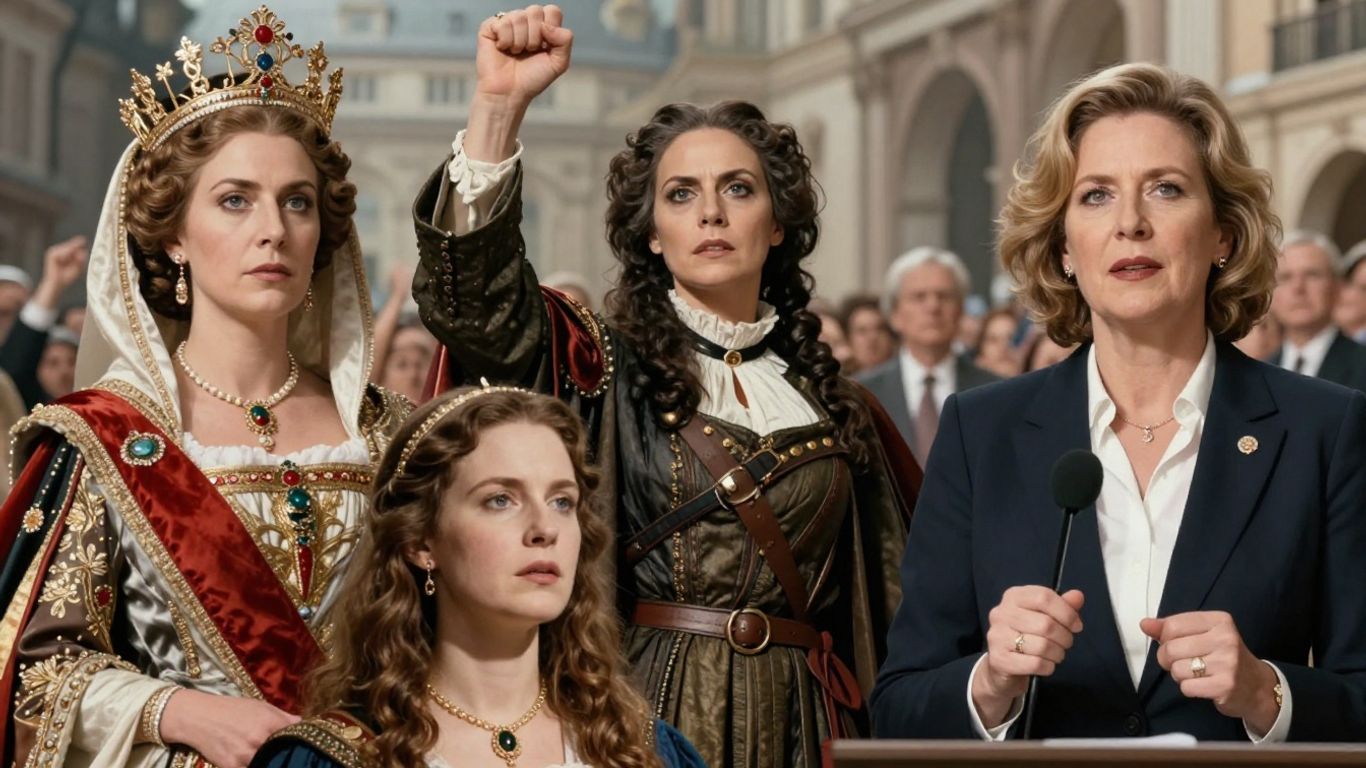
Jacinda Ardern: Compassionate Leadership in Crisis
When the world was grappling with the COVID-19 pandemic, Jacinda Ardern, then Prime Minister of New Zealand, showed a different way to lead. Instead of just reacting, she acted fast, communicating with her country in a way that was both strong and kind. She announced a clear alert system, and her message to "Please be strong, be kind, and unite against COVID-19" really stuck with people. It wasn’t just about the virus; it was about bringing people together. Countries led by women, like New Zealand, often saw better results during the pandemic, with fewer deaths. This suggests that a more empathetic approach can be really effective when things get tough. It’s a good reminder that leadership isn’t just about making tough calls, but also about how you connect with people. Learning more about women in leadership can show us how diverse styles can work.
Angela Merkel: Navigating Europe’s Future
Angela Merkel led Germany for a long time, and during her tenure, she became a central figure in European politics. She was known for her calm and steady approach, especially during challenging times like the eurozone debt crisis and the refugee situation. Merkel wasn’t one for grand speeches; her strength was in her quiet determination and her ability to find common ground. She often worked behind the scenes, building consensus among different countries. Her pragmatic style helped keep things stable in a sometimes-turbulent Europe.
Margaret Thatcher: The Iron Lady’s Legacy
Margaret Thatcher was a force to be reckoned with as the Prime Minister of the United Kingdom. She earned the nickname "The Iron Lady" for her strong will and unyielding policies. Thatcher wasn’t afraid to make big changes, even when they were unpopular. She believed in reducing the power of unions and privatizing state-owned companies, which significantly reshaped Britain’s economy. Her leadership style was direct and often confrontational, but she undeniably left a lasting mark on her country and on the world stage.
These women, each in their own way, demonstrated that effective leadership comes in many forms, challenging old ideas about what a leader should be.
It’s interesting to think about the different ways these leaders approached their roles:
- Jacinda Ardern: Focused on empathy, clear communication, and national unity during a global crisis.
- Angela Merkel: Prioritized stability, consensus-building, and pragmatic problem-solving in complex international relations.
- Margaret Thatcher: Championed decisive action, economic reform, and a strong, often uncompromised, political will.
The path for women in leadership has often been harder, facing stereotypes about emotions and work-life balance. Yet, these modern leaders show that qualities like compassion, steady resolve, and a clear vision are what truly matter. Their successes highlight the need for more diverse leadership styles in politics and beyond.
Groundbreaking Artists and Cultural Icons
Frida Kahlo: Painting through Pain and Identity
Frida Kahlo’s art is like a raw, unfiltered diary. She painted herself, a lot, and didn’t shy away from showing the pain, the struggles, and the sheer intensity of her life. Born in Mexico, she faced so many health issues from a young age, including polio and a terrible bus accident that left her with lifelong injuries. These experiences deeply shaped her work. Her self-portraits are famous for their bold colors and symbolic imagery, often mixing reality with fantasy. She used her art to explore her identity, her heritage, and the complex emotions she felt. It wasn’t just about pretty pictures; it was about survival and making sense of a difficult world.
Artemisia Gentileschi: Pioneering Baroque Master
Artemisia Gentileschi was a force to be reckoned with in 17th-century Italy, a time when the art world was pretty much an all-boys club. Trained by her father, she quickly surpassed him, developing a style that was dramatic and full of emotion. She’s known for her powerful depictions of women, often taking on biblical and mythological stories and giving the female characters a strength and agency rarely seen before. Think Judith beheading Holofernes – it’s intense, and you can feel the raw power. She faced her own share of hardship, including a very public trial for rape, and many believe her experiences fueled the fierce spirit in her paintings.
Maya Lin: Redefining Public Memory
Maya Lin’s design for the Vietnam Veterans Memorial in Washington D.C. was a game-changer. When she was just a student, her design won a competition, but it wasn’t without controversy. People weren’t used to a memorial that was so minimalist and reflective, a long, dark wall inscribed with names. But that’s exactly what made it so powerful. It doesn’t tell you who to praise or blame; it just presents the names, allowing for personal reflection and a sense of shared grief. Her work challenges how we think about monuments and remembrance. It’s a quiet space that speaks volumes about loss and healing.
Here are some key aspects of her approach:
- Minimalist Aesthetics: Lin often favors clean lines and simple forms.
- Integration with Landscape: Her works frequently interact with their natural surroundings.
- Focus on Viewer Experience: The emotional and psychological impact on the person engaging with the art is paramount.
Lin’s ability to create spaces that evoke deep emotional responses, often with very few elements, is remarkable. She forces us to confront complex ideas through quiet contemplation, proving that art doesn’t need to be loud to be impactful.
Trailblazers in Science and Innovation
Marie Curie: Transforming Modern Science
Marie Curie wasn’t just a scientist; she was a force of nature. Born in Poland, she moved to Paris to pursue her education, a path not easily trod by women back then. She ended up being the first woman to win a Nobel Prize, and then, get this, she won a second one in a different field! That’s pretty wild. Her work with radioactivity, alongside her husband Pierre, was groundbreaking. They discovered two new elements, polonium and radium. Her relentless pursuit of knowledge changed how we understand the very building blocks of the universe.
Curie’s contributions weren’t just theoretical. During World War I, she developed mobile X-ray units, nicknamed "petites Curies," which helped save countless soldiers’ lives on the battlefield. Imagine driving around with X-ray machines in vans – pretty innovative for the time.
The scientific world often overlooks the contributions of women, a phenomenon known as the Matilda Effect. It’s a reminder that history books might not always tell the full story, and many brilliant minds have been left in the shadows.
Ada Lovelace: Visionary of Computer Programming
Ada Lovelace, born in the early 19th century, is often called the first computer programmer. That’s a big title, right? She worked with Charles Babbage on his proposed mechanical general-purpose computer, the Analytical Engine. While Babbage focused on the hardware, Lovelace saw something more. She wrote notes on the machine, and in those notes, she described an algorithm intended to be processed by the machine. This was way ahead of its time, long before actual computers existed.
Her vision went beyond just calculations. She imagined that machines could do more than just crunch numbers; they could potentially create music or art. It’s like she saw the future of computing, the digital age, before anyone else even had the tools to build it.
Here’s a look at some key aspects of her work:
- Analytical Engine Notes: Her detailed annotations on the machine were more extensive than Babbage’s original paper.
- First Algorithm: She published what is considered the first algorithm intended for implementation on a computer.
- Visionary Ideas: She foresaw the potential for computers beyond mere calculation.
Katherine Johnson: Calculating a Path to the Stars
Katherine Johnson was one of the brilliant minds at NASA who made the early space missions possible. You might know her from the movie "Hidden Figures." She was a mathematician, a "human computer," who calculated trajectories, launch windows, and emergency return paths for the Apollo missions, including the one that landed on the moon. Her accuracy was so legendary that John Glenn specifically requested she re-check the calculations for his Friendship 7 flight before he’d go up.
Working at NASA in the 1960s, especially as an African American woman, was incredibly challenging. She faced segregation and had to fight for her place. But her talent and dedication couldn’t be ignored. She was a trailblazer who proved that intellect and skill know no color or gender.
Her work involved complex calculations, and here’s a simplified look at what she did:
- Orbital Mechanics: Figuring out the paths spacecraft would take.
- Navigation: Plotting courses for missions.
- Safety Checks: Ensuring safe returns to Earth.
These women, Curie, Lovelace, and Johnson, represent just a fraction of the female talent that has driven scientific progress. Their stories remind us to look closely at history, because so many important contributions have been made by women whose names we might not always hear first. It’s important to recognize their impact on science and technology today.
Champions of Rights and Social Justice
Claudia Jones: Fighting for Black Liberation
Claudia Jones was a force to be reckoned with, a Trinidadian-born activist and journalist who made her mark in London. She was a fierce advocate for the rights of Black people, women, and the working class. Jones didn’t just talk about change; she actively worked to create it, organizing and speaking out against injustice. She was a key figure in the Pan-African movement and a strong voice against racism and colonialism. Her work laid important groundwork for future civil rights movements.
Susan B. Anthony: Advancing Women’s Suffrage
Susan B. Anthony is a name many of us know from history class, and for good reason. She dedicated her life to fighting for women’s right to vote in the United States. It wasn’t an easy fight; she faced arrest and public criticism, but she never backed down. Anthony traveled extensively, giving speeches and organizing campaigns to get women the voice they deserved in government. Her relentless pursuit of equality paved the way for women to participate fully in democracy.
Malala Yousafzai: Global Advocate for Education
Malala Yousafzai’s story is one of incredible bravery. Shot by the Taliban for daring to go to school in Pakistan, she survived and turned her experience into a global platform. Malala became a powerful advocate for girls’ education worldwide, believing that every child deserves to learn. She co-founded the Malala Fund, which works to secure free, safe, and quality education for girls everywhere. Her work has inspired millions and brought attention to the barriers many girls face in getting an education.
Here’s a look at some key aspects of their work:
- Claudia Jones: Focused on anti-racism, women’s rights, and labor issues, particularly within the Black community in London.
- Susan B. Anthony: Championed women’s suffrage through tireless campaigning, public speaking, and organizing.
- Malala Yousafzai: Advocates for global education, especially for girls, through her foundation and public speaking.
These women, in their own ways and in their own times, challenged the status quo. They understood that true progress requires fighting for the rights of all people, not just a select few. Their legacies remind us that one person’s voice, amplified by conviction and action, can indeed change the world.
More Than Just Names in a Book
So, we’ve looked at some seriously impressive women who totally changed the game. It’s easy to just read about them and move on, but these ladies weren’t just figures in history books. They faced down huge challenges, often with barely anyone in their corner, and still managed to make a real difference. Their stories show us that leadership and making an impact aren’t just for one type of person. It’s a good reminder that there are always more stories out there waiting to be found, and that we should keep looking for them. Hopefully, learning about these trailblazers makes you think about the power we all have to shape things, big or small.
Frequently Asked Questions
Who are some of the most famous female leaders from ancient times?
Ancient Egypt had powerful female rulers like Hatshepsut, who was a pharaoh and brought great wealth and trade to her kingdom. In the Roman era, Zenobia was a queen who bravely challenged the Roman Empire. These women showed incredible strength and leadership even when facing tough challenges.
What makes leaders like Queen Elizabeth I and Queen Victoria so important?
Queen Elizabeth I guided England through a golden age, a time of great art and exploration, showing smarts and determination. Queen Victoria ruled a huge empire for many years, and her time, the Victorian Era, was known for big changes in science and society. Both proved women could lead nations successfully.
How did women like Rosa Luxemburg and Claudia Jones change things?
These women were revolutionaries who fought for big social and political changes. Rosa Luxemburg was a strong voice for the left in Europe, and Claudia Jones worked hard for the rights of Black people. They were brave thinkers and speakers who wanted a fairer world for everyone.
Can you give an example of a female leader who was also a military figure?
Amina of Zaria was a queen in what is now Nigeria who was known as a warrior. She strengthened her army and expanded her kingdom’s territory and trade routes. Joan of Arc in France is another famous example, a young woman who inspired soldiers to fight for their country.
What are some modern examples of powerful female leaders?
In recent times, leaders like Jacinda Ardern in New Zealand showed compassionate leadership during crises. Angela Merkel led Germany for many years, guiding Europe through difficult times. Margaret Thatcher, known as the ‘Iron Lady,’ was a strong leader who significantly changed Britain’s economy.
Besides politics and leadership, where else have women made a big impact?
Women have also been amazing in science, art, and fighting for rights. Marie Curie was a brilliant scientist who won Nobel Prizes. Frida Kahlo used her art to express deep feelings and identity. Malala Yousafzai became a global voice for girls’ education, showing that women’s influence spans many important areas.